
Hospital Morgue Design Guide | Layout, Equipment & Refrigeration
Hospital Morgue Design Guide | Layout, Equipment & Refrigeration
Designing a hospital morgue is one of the most technically exacting projects a facilities team will undertake. Unlike general clinical spaces, a hospital morgue must simultaneously satisfy federal OSHA bloodborne pathogen standards, state health department body-storage codes, Joint Commission environment-of-care requirements, and the operational realities of a working pathology service. Getting the layout, refrigeration sizing, and HVAC zoning right from the start saves tens of thousands of dollars in retrofitting costs and prevents the compliance gaps that lead to citations.
This guide walks hospital administrators, facilities directors, and architects through every major decision point in hospital morgue design — from siting and regulatory requirements to refrigeration unit selection and ventilation zoning.
Regulatory Requirements for Hospital Morgue Rooms
Three primary regulatory frameworks govern hospital morgue design in the United States.
OSHA Bloodborne Pathogen Standard (29 CFR 1910.1030)
OSHA's bloodborne pathogen standard is the foundation of hospital morgue design. It mandates engineering controls — including negative-pressure ventilation, impermeable work surfaces, and proper decontamination facilities — in any space where staff may encounter blood or other potentially infectious materials. Autopsy suites must maintain negative pressure relative to adjacent corridors and provide a minimum of 12 air changes per hour in new construction. Decontamination sinks, eyewash stations, and labeled biohazard waste containers are required installations, not optional upgrades.
FGI Guidelines for Design and Construction of Hospitals
The Facility Guidelines Institute (FGI) publishes the most widely adopted standards for healthcare construction. The FGI Guidelines require that hospital morgues include a separate body-receiving area, a body-holding room with adequate refrigeration, and, where autopsies are performed, a dedicated autopsy suite. Staff access routes must not intersect with family/visitor corridors, and the body removal route must be screened from public view — ideally through a covered exterior loading area.
State Health Department Codes
Every state adds its own layer of requirements. Most state codes specify minimum refrigeration capacity relative to hospital bed count, acceptable temperature ranges for body storage (typically 34°F–38°F), and licensing requirements for the space. Before finalizing any design, obtain written guidance from your state health department to avoid late-stage plan changes.
Hospital Morgue Layout Planning: Single vs. Multi-Body Configurations
Layout decisions depend primarily on case volume and available square footage. The International Association of Forensic Nurses and the FGI both recognize two broad configurations:
Small-Hospital Configuration (Under 150 Beds)
- Body holding: 1–4 body positions using upright refrigerated cabinets
- Exam space: A single multi-purpose prep/viewing room
- Footprint: 300–500 sq ft total dedicated morgue space
- Refrigeration: 2–4 body upright or roll-in units provide the most space-efficient solution
Mid-Size Hospital Configuration (150–400 Beds)
- Body holding: 4–10 body positions; walk-in or high-density upright units
- Exam space: Dedicated autopsy suite separate from holding area
- Support spaces: Grieving room, staff PPE anteroom, dirty utility
- Footprint: 800–1,500 sq ft total
Large Hospital Configuration (400+ Beds)
- Body holding: 10–20+ body positions; walk-in cooler suite preferred
- Exam suite: Two or more autopsy tables with independent downdraft ventilation
- Ancillary spaces: Tissue storage, family reception suite, staff locker room, equipment storage
- Footprint: 2,000–4,000+ sq ft
The critical design rule across all configurations: body transport routes from patient care floors must never pass through public corridors. Dedicated service elevators with coded access are the standard solution.
Refrigeration Capacity Calculation by Bed Count
The industry benchmark — widely used by hospital planners and consistent with FGI guidance — is to plan for body storage capacity equal to approximately 0.5% to 1% of licensed bed count, adjusted upward for teaching hospitals, trauma centers, or facilities in high-mortality demographic markets.
Formula: Minimum body positions = Licensed beds × mortality rate (%) × average length of stay factor
Practical benchmarks by bed count:
- 100-bed hospital: 2–4 body positions minimum
- 200-bed hospital: 4–6 body positions
- 400-bed hospital: 6–10 body positions
- 600-bed hospital: 10–16 body positions
Always add a 20–30% surge buffer. Mass casualty events, seasonal mortality spikes (flu season, heat waves), and extended hold times due to medical examiner coordination all create temporary demand well above baseline. A facility that is at capacity under normal conditions will be critically undersupplied during a crisis.
Walk-In vs. Upright Unit Selection
The refrigeration unit type is the most consequential procurement decision in hospital morgue design.
Upright Refrigerated Cabinets
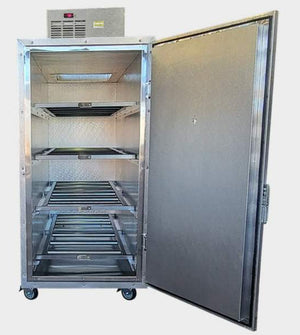
Upright units are best for facilities requiring 1–6 body positions in constrained square footage. They can be installed without structural modification, connect to standard electrical service, and are easily expandable by adding units as case volume grows. Our upright mortuary cooler collection includes 3-body, 4-body, 6-body, 10-body, and 12-body configurations — all built with Type 304 stainless interiors and precision digital temperature controls.
Walk-In Refrigeration Suites
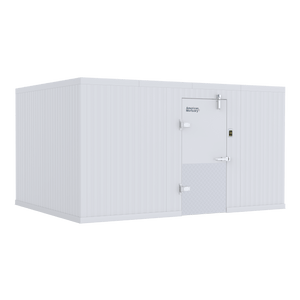
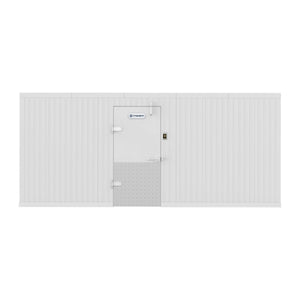
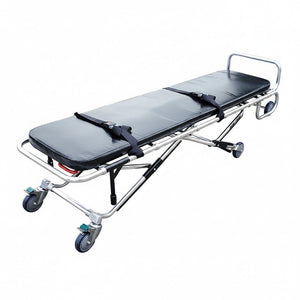
Walk-in units become the preferred choice at 8+ body positions or when the facility needs to accommodate full-gurney entry without body transfer. Standard hospital walk-in sizes include 8×10 ft (10–12 bodies), 10×12 ft (14–16 bodies), and 10×16 ft (18–22 bodies). Walk-ins allow staff to use rolling carts without transfer, reducing manual handling injury risk and maintaining greater dignity. Explore our walk-in mortuary cooler collection for modular, cam-lock panel systems that install without welding or structural alteration.
HVAC and Zoning Considerations
Morgue HVAC design is significantly more demanding than standard clinical HVAC. Key requirements include:
- Negative pressure: The autopsy suite and body-holding area should maintain negative pressure relative to all adjacent spaces, preventing odors and potential bioaerosols from migrating into corridors or other clinical areas.
- Air changes: ASHRAE Standard 170 recommends a minimum of 12 air changes per hour (ACH) in autopsy/prep rooms, with all exhaust 100% exhausted to the exterior — no recirculation.
- Temperature zoning: The body-holding refrigeration area and the staff work area require separate HVAC zones. The refrigeration unit handles body-storage temperature; the surrounding room is maintained at 60°F–65°F for staff comfort while reducing refrigeration load.
- Humidity control: Relative humidity in the 50–60% range prevents condensation on refrigeration equipment and reduces microbial growth on surfaces.
- Dehumidification in walk-in units: Walk-in morgue coolers should be specified with an integrated dehumidifier to prevent ice buildup and maintain consistent interior temperatures.
Siting the Morgue Within the Hospital
Optimal siting balances operational efficiency with dignity and discretion:
- Ground floor preferred for direct exterior access — eliminating elevator dependency for body removal
- Proximity to the emergency department and ICU to minimize transport distance
- Separate from patient-facing areas such as oncology, pediatrics, and main visitor lobbies
- Loading dock adjacency for discreet remains transfer to funeral homes
Getting the Equipment Right from Day One
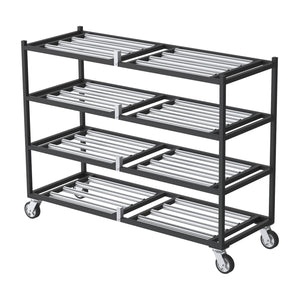
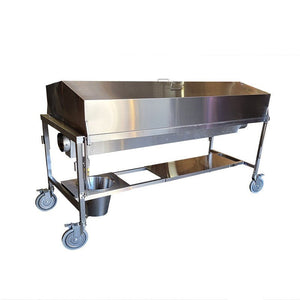
Hospital morgue design failures are almost never architectural — they're equipment failures. Under-specified refrigeration, undersized walk-ins, and missing racks or lifts create operational problems on day one. American Mortuary Coolers engineers hospital-grade refrigeration systems purpose-built for institutional use, with UL/NSF components, OSHA-compliant construction, and USA manufacturing backed by our BBB A+ rating and NFDA 2026 Supplier designation.
Whether you need a compact upright for a 100-bed community hospital or a 10×16 walk-in suite for a regional trauma center, we provide the specifications, layout support, and procurement documentation your facilities team needs. View our full hospital morgue design equipment collection or contact our team at 1-888-792-9315 to begin your project consultation.

