
Mass Fatality PPE Stockpile Guide: How Much to Keep and How to Store It

Short answer: Plan PPE per decedent, not per staff member. Multiply the PPE each person uses per decedent by the number of people handling each one, then by your planning surge, and add 20 to 30% for breakage, sizing misses and re-donning. Store it sealed, by size, with a written rotation date.
Why mass fatality PPE runs out
Hospitals, medical examiners and funeral homes that went through 2020 learned that PPE runs out before cooler space does. Supply chains tighten at the same moment demand spikes, and every responder change, meal break and torn glove consumes a full set. The CDC's guidance on handling human remains and OSHA's postmortem care guidance both assume standard precautions plus fluid-resistant gowns or coveralls, gloves and eye protection for every handler, which is a lot of single-use PPE.
The per-decedent math
Use this formula for each item:
Units needed = decedents × handlers per decedent × units per handler × 1.25 safety factor
A typical intake, storage and release workflow touches each decedent two to four times: recovery or removal, intake and documentation, storage moves, and release. Count every handler at every step.
Planning table for a 100-decedent surge
| Item | Assumption | Units | Cases |
|---|---|---|---|
| Nitrile exam gloves | 3 handlers × 4 steps × 2 pairs (double) = 48 gloves | ~6,000 gloves | About 6 cases of 1,000 |
| Disposable coveralls | 3 handlers × 2 changes | ~750 | About 30 cases of 25 |
| Hood and boot coveralls for recovery | Recovery team only | ~200 | 8 cases of 25 |
| Tychem coveralls for decon and fluids | Decon line and spill cleanup | ~60 | 5 cases of 12 |
| Face shields and N95 respirators | One per handler per shift | Varies by shifts | Plan by shift |
Glove case counts vary by product, so check the pack size on each glove page. Adjust handlers and steps to your own workflow.
Match the PPE to the incident
- Natural disaster, heat, flood or pandemic surge: SMS coveralls for dry handling and PE-coated fluid-resistant coveralls for intake and fluids. Microporous cool-back coveralls help with heat stress in tents and trailers.
- Transportation or industrial incident with fuels or chemicals: Tychem 2000 or Tychem 4000 coveralls with chemical gloves and boots.
- Known or suspected chemical, biological or radiological contamination: remains are decontaminated by hazmat teams in Level A or B. See our PPE levels A–D guide and the Tychem 10000 Level A suit.
 SMS coverall, hoodfrom $89.95
 PE-coated coverall, hood & bootsfrom $135.95
 Microporous cool-back coverallfrom $124.95
 Tychem 2000 QC127from $198.95
Storage, sizing and rotation
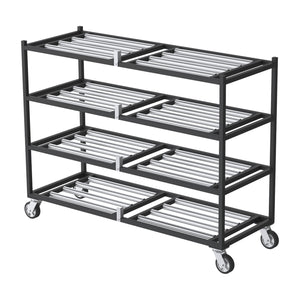
- Store sealed cases off the floor in a cool, dry, dark room. Heat and UV degrade films and elastic.
- Stock sizes in a bell curve: roughly 10% M, 30% L, 30% XL, 20% 2XL and 10% 3XL and up for coveralls.
- Label each shelf with size, lot and the date received, and rotate older stock into daily use.
- Keep a one-page donning and doffing sheet with the stockpile.
For cooler and storage capacity planning, see our mass fatality surge capacity page.
2026 Year-End PPE Stock-Up
Mix gloves, coveralls, DuPont Tychem and embalming coats in one order. Coverall, Tychem and coat cases save 3% at 3 cases up to 10% at 20, and all PPE ships free at $1,500 to the Lower 48.
Build your PPE orderShop mortuary PPEFrequently asked questions
How much PPE should a funeral home stockpile for a surge?
Multiply your planning surge in decedents by handlers per decedent and units per handler, then add 20 to 30%. A 100-decedent plan with three handlers typically needs about 6,000 gloves and 750 coveralls.
What PPE does CDC recommend for handling human remains?
Standard precautions: gloves, fluid-resistant gowns or coveralls, and eye protection such as goggles or a face shield, with additional protection when splashes or aerosols are likely.
Do disposable coveralls expire?
Most do not carry a hard expiration date, but films, elastic and seam tape can degrade with heat and UV. Store sealed and rotate stock into daily use.
Which coverall is best for a hot surge site?
A breathable microporous coverall with a cool-back panel reduces heat stress. Use fluid-resistant PE-coated or Tychem coveralls at stations with fluid exposure.
Related PPE guides
- OSHA PPE Requirements for Embalmers
- How to Choose Disposable Coveralls for Embalming, Removals and Response
- COVID-19 and Infectious Disease Decedent Care
- OSHA PPE Levels A, B, C and D
- New Funeral Home PPE Checklist
- Funeral Home OSHA PPE Compliance by State
- Prep Room PPE Problems and Solutions
- OSHA Formaldehyde Standard for Funeral Homes
- Mortuary PPE · Disposable coveralls · DuPont Tychem · Exam gloves by the case

