
How to Choose a Battery-Powered Scissor Lift for a Crematory
A crematory scissor lift raises a case from storage or cot height to the retort door so operators stop lifting by hand. This guide covers the measurements that matter and compares powered, hydraulic and lift-table options.

Charging a retort is one of the heaviest lifts in deathcare. Cases routinely run 200 to 400 pounds or more with the container, and the retort door sits well above cot height. A scissor lift replaces that lift with a button or a foot pump, and it is one of the simplest injury-prevention purchases a crematory can make.
Quick answer: Measure the retort door sill height, the lowest surface you load from (cooler tray, rack tier or cot), and your heaviest typical case. Pick a lift whose lowered height is at or below the lowest surface, whose raised height reaches the retort sill, and whose capacity covers bariatric cases. Battery-powered lifts suit busy, single-operator crematories; manual hydraulic lifts cost less and need no charging.
Five Measurements Before You Order
| Measure | Why it matters |
|---|---|
| Retort door sill height | Sets the minimum raised height the lift must reach |
| Lowest loading surface | Floor tray, bottom rack tier or cot; sets the maximum lowered height |
| Heaviest typical case with container | Choose capacity with margin; 1,000 lb covers bariatric work |
| Transfer direction | End loading versus side loading changes the deck you need |
| Floor space and path | Room to turn a loaded lift between cooler, scale and retort |
Powered, Hydraulic and Lift-Table Options
| Lift | Capacity | Operation | Best fit |
|---|---|---|---|
| Low Profile Powered Crematory Lift | 1,000 lb | Powered double scissor; with or without integrated scale | Busy crematories loading from low trays |
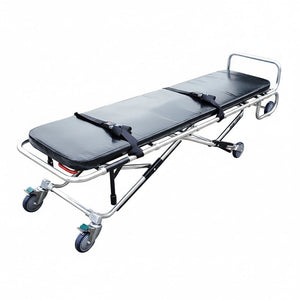
| Powered Scissor Lift Aluminum Alloy | 1,000 lb | Powered; aluminum frame | Single operators who move the lift often |
| HD 1000 MAX Mortuary Lift G1 | 1,000 lb class | Powered; multi-directional top | Mixed end- and side-load transfers |
| 1,000 lb Hydraulic Crematory Lift | 1,000 lb | Manual hydraulic | Lower volume, no charging needed |
| Hydraulic Crematory Lift Table | 1,000 lb | Hydraulic lift table | Fixed loading station at the retort |
 Low Profile Powered Crematory Lift | 1,000 lb Mortuary Scissor Lift1,000 lb, low profile
 Powered Scissor Lift Aluminum AlloyAluminum, 1,000 lb
 1,000 lb Hydraulic Crematory Lift | Manual Mortuary Scissor LiftManual hydraulic
 Hydraulic Crematory Lift Table, 1,000 lb – AME 1030-LT2Lift table
 Crematory Digital Scale with Ramp – AME 1030-DSRScale with ramp
 Lift Table Safety Skirt – AME 1030-LTSKPleated safety skirt
Battery Care and Daily Use
- Park powered lifts on the charger at the end of each shift, and keep a charging outlet near the cooler or retort.
- Inspect the scissor arms, pins and hydraulic lines weekly. A pleated safety skirt keeps hands and debris out of the mechanism.
- Lock casters before every transfer.
- Record case weight on a roll-on floor scale for the operator log.
When to Step Up to an Auto Charger
High-volume crematories often add a mechanized charger so one operator can push the case into the chamber without standing at the open door. Compare the Crematory Auto Loader and 1,000 lb Crematory Auto Charger, or browse crematory lifts, chargers and scales.
Holding capacity before cremation is covered in how long a body can be refrigerated before cremation. General body lift choices are compared in funeral home body lifts.
Frequently Asked Questions
What capacity should a crematory lift have?
Most crematories choose a 1,000 lb lift so bariatric cases with containers are covered with margin.
Battery-powered or hydraulic crematory lift?
Battery-powered lifts raise at the press of a button and suit busy, single-operator shifts. Manual hydraulic lifts use a foot pump, cost less and never need charging.
How do I know a lift will reach my retort?
Compare the lift's maximum raised height with the retort door sill height, and its lowered height with your lowest tray or rack tier. Send us both measurements and we will check fit before you order.
Do I need a scale with the lift?
Many operators record case weight before cremation. You can choose a lift with an integrated scale or use a separate roll-on floor scale.
Questions about fit, freight or lead time? Call our Johnson City, Tennessee team at 1-888-792-9315 or email cool@mymortuarycooler.com.

