Refrigeration
A condensing unit and evaporator remove heat and hold the setpoint. Self-contained units plug into a standard circuit. Larger walk-ins use split systems sized to the box, often with a 208/230-volt upgrade.

Your cart is empty
Browse mortuary coolers, freezers, cots and pathology equipment, then add the models you want to order or compare.
Shop by category
0% financing offers are through Shop Pay with approved credit. Purchase orders accepted — see financing.
Resources
Mortuary coolers and morgue cooling systems: how refrigeration, insulation and rack layouts work, plus upright, roll-in, vault and walk-in systems.
Mortuary Coolers - Morgue Cooling Systems
A morgue cooling system is more than a cold box. It is a refrigeration system, an insulated enclosure, and a rack and tray layout working together to hold remains at a steady temperature, typically 34 to 38°F for short-term mortuary storage. This page explains how each part works and how to choose the system that fits your facility.
A condensing unit and evaporator remove heat and hold the setpoint. Self-contained units plug into a standard circuit. Larger walk-ins use split systems sized to the box, often with a 208/230-volt upgrade.
Foamed panels and tight door gaskets keep the cold in. Thicker insulation and a proper floor lower run time and protect the compressor. See our insulation guide.
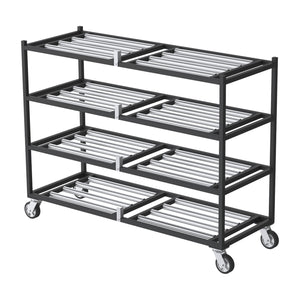
The storage system sets the capacity. Roller racks, cantilever racks, trays and boards decide how many bodies fit and how easily they move in and out.
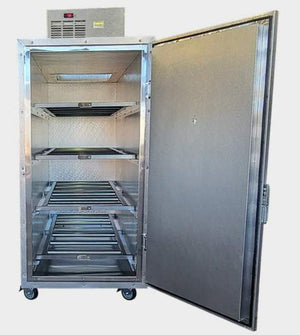
Cooler racks and body trays →Two- to twelve-body cabinets with tiered trays. The most storage per square foot for funeral homes and hospitals with limited floor space.
Shop upright coolers →Bodies stay on the cot or carrier and roll straight in at cot height, so staff never lift to an upper tier.
Shop roll-in coolers →The most common size for a single-location funeral home: upright, side-load, bariatric and triple-wide roll-in formats.
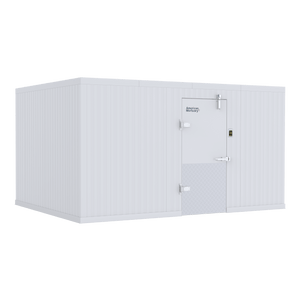
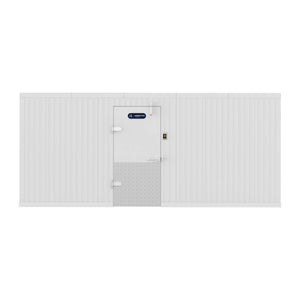
Shop 3-body coolers →Modular rooms from 6x8 to 20x40 feet with rack layouts for 6 to 40+ bodies and space to grow.
Shop walk-in coolers →Individual compartments with slide-out trays for hospital, pathology and medical examiner suites.
Shop vault coolers →Lower-temperature storage for long-term holds, anatomy programs and extended investigations.
Shop mortuary freezers →| System | Capacity | Loading | Best fit |
|---|---|---|---|
| Upright cabinet | 2 to 12 bodies | Tiered trays, lift recommended | Funeral homes with limited floor space |
| Roll-in | 2 to 3 bodies | At cot height, no lifting | Small teams that want to avoid lifting |
| Side-load upright | 3 bodies | From the long side | Rooms where depth is limited |
| Vault / multi-bay | 2 to 15 bodies | Individual doors, slide-out trays | Hospitals, pathology, medical examiners |
| Walk-in room | 6 to 40+ bodies | Racks on casters, lift access | Regional, county and high-volume facilities |
 2 Body Standard Roll-In Mortuary CoolerCot-level loading for smaller facilities
 3 Body Standard Mortuary CoolerThree-tier upright storage
 3 Body Triple-Wide Roll-In CoolerThree bodies side by side at cot height
 4 Body Bariatric Mortuary CoolerWider tiers for larger decedents
 6 Body Dual-Door Mortuary CoolerTwo compartments, one footprint
 12 Body Triple-Door Mortuary CoolerThree doors, three 4-tier racks included
 10x10 Walk-In Mortuary CoolerRoom for three 4-tier racks
 10x16 Walk-In Mortuary CoolerExpansion room for high-volume work
Manuals, parts and troubleshooting are on our tech support hub.
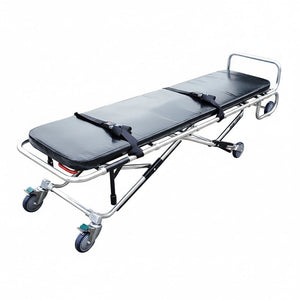
Storage capacity is set by the rack and tray system inside the cooler, and safe handling depends on the lift that serves it. These are the rack, tray and lift models buyers pair with our coolers most often. See the full mortuary lifts, racking systems and storage trays collection for every size and configuration.
 4-Tier End-Loading Mortuary RackFour bodies per rack, loaded from the foot end
 4-Tier Side-Loading Mortuary Rack31" x 85" footprint, 21" first tier
 4-Tier Cantilever Mortuary RackOpen-front arms, mobile or stationary
 TITAN 23" Stainless Steel Body Tray78" long, 18 gauge, hand slots
 HD Mortuary Plastic Storage Board23.5" x 76" HDPE barrier board
 Hydraulic Crematory Scissor Lift1,000 lb, foot-pump hydraulic
 Low Profile Powered Crematory Lift12" low load height, 12V battery
 1,000 lb Casket & Body LifterStrap lifter, 31" to 72" boom
Most short-term mortuary storage is held between 34 and 38°F. Long-term holds and anatomy programs use mortuary freezers at much lower temperatures.
In a self-contained system, all refrigeration components sit on the cooler. A split system puts the condensing unit elsewhere, which is common on walk-in rooms and moves heat and noise out of the work area.
With clean coils, sound gaskets and regular service, the enclosure lasts many years. The refrigeration components are the parts that eventually wear out and can be replaced.
Walk-in rooms usually benefit from an insulated floor, especially over slab-on-grade. Our floor guide explains when it matters.
Financing is available through Shop Pay, including 0% offers with approved credit.
Send your room size, door opening, capacity and receiving details. We will match the cooler, racks and lift and quote freight to your dock.
Third-party programs, ratings and eligibility can change. Select a profile to verify its current details.
Cabinet mortuary coolers built in Johnson City, Tennessee, plus the affordable funeral supply funeral homes, crematories and morgues rely on: embalming tables, mortuary cots and stretchers, mortuary racks and lifts, crematory equipment, chapel furniture, register books and memorial stationery. Shop online or call 1-888-792-9315.

