


Morgue Cooler Capital Budget Planning 2026 | ME & Hospital Guide
Morgue Cooler Capital Budget Planning 2026 | ME & Hospital Guide
Capital budget planning for morgue refrigeration is rarely straightforward. Unlike clinical equipment categories with established procurement pathways, morgue coolers sit at the intersection of facilities management, pathology, compliance, and finance—and administrators often find themselves navigating the process without a clear roadmap.
This guide provides hospital administrators, medical examiner office directors, and facilities managers with a structured, step-by-step approach to planning and executing a morgue cooler capital procurement in 2026. From initial needs assessment through installation, we cover every stage—including how to make the budget justification case that gets approved on the first submission.
Step 1: Conduct a Formal Needs Assessment
Before writing a budget request, quantify the problem. A strong needs assessment answers four questions:
- Current capacity vs. actual demand: How many decedents does your facility hold on a peak day? What is the maximum your current storage accommodates? Document any overflow incidents in the past 12 months.
- Compliance status: Does current storage meet OSHA 29 CFR 1910.1030, state health department standards, and CMS Conditions of Participation (for hospitals)? Document any deficiencies noted in the last survey or inspection.
- Operational cost of inadequate storage: Calculate current costs of body transfers to external facilities, contracted storage fees, and staff overtime related to transport logistics.
- Equipment age and condition: If replacing existing equipment, document age, service history, and estimated remaining useful life. Equipment over 10 years with increasing repair frequency is a strong replacement justification.
Step 2: Define Equipment Specifications
Finance committees respond to specificity. Vague requests ("a new morgue cooler") rarely survive competitive budget review. A well-specified request includes:
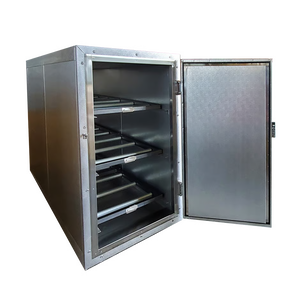
- Unit type: Upright (single or multi-body), walk-in, vault-style, or combination. See our morgue refrigeration collection for a full range of configurations.
- Capacity: Number of decedent positions required at 95th-percentile daily census (not average).
- Compliance certifications: UL-listed, NSF-compliant components, OSHA-compatible design.
- Utility requirements: Power (208V or 115V), drainage, floor load rating, door clearances.
- Warranty terms: American Mortuary Coolers provides industry-leading warranty coverage on all USA-manufactured units.
- Installation requirements: Is professional installation required? Factor into total budget request.
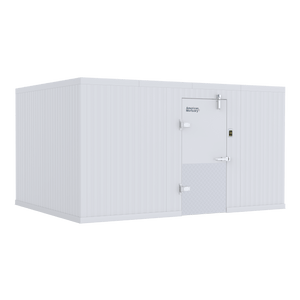
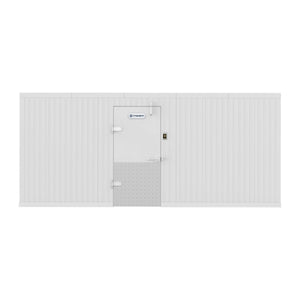
For large facilities requiring walk-in capacity, our 8×10 walk-in, 10×12 walk-in, and 10×16 walk-in configurations address even high-volume hospital morgue demand.
Step 3: Conduct Vendor Comparison
Finance committees expect competitive analysis. Document at least three vendors with pricing, lead times, warranty terms, and service coverage. Key comparison points for morgue refrigeration:
| Factor | AMC | What to Ask Competitors |
|---|---|---|
| Country of manufacture | USA (Johnson City, TN) | Where is it manufactured? |
| Component certifications | UL/NSF listed | Are components UL/NSF listed? |
| Warranty | Industry-leading | What's covered and for how long? |
| Lead time | 2–3 weeks typical | Current lead time? |
| Service network | Direct + national partners | Who services the unit? |
| Financing | 0% direct financing available | Do they offer financing? |
American Mortuary Coolers is an NFDA 2026 Supplier and BBB A+ rated. Our equipment ships fully assembled and tested from our Tennessee facility. We do not use third-party distributors, which means no markup layers and direct accountability on every order.
Step 4: Build the Budget Justification Document
A budget justification for a finance committee should address three elements: why now, why this amount, and what happens if we don't.
Why Now
Reference your needs assessment data: overflow incidents, compliance deficiencies, equipment age, rising maintenance costs, or regulatory inspection findings.
Why This Amount
Provide the full cost breakdown: equipment purchase price, installation, utility modifications (if required), and ongoing maintenance budget. Include financing cost if applicable (or highlight $0 interest cost if using AMC's 0% financing program).
What Happens If We Don't
Quantify risk: OSHA fine exposure ($15,625+ per willful violation), CMS citation risk (which can threaten hospital accreditation), ongoing external storage costs, and reputational risk from inadequate decedent care. This section often moves capital requests from "nice to have" to "must fund."
Step 5: Establish Procurement Timeline
Capital equipment procurement for hospitals and government agencies typically requires 60–180 days from budget approval to delivery. A realistic timeline:
- Weeks 1–2: Issue RFQ or sole-source justification; collect vendor quotes
- Weeks 3–4: Evaluate bids; select vendor; negotiate terms
- Weeks 5–6: Finalize financing if applicable (AMC financing decisions in 24–72 hours)
- Weeks 7–9: Purchase order issued; equipment manufactured/prepared for shipment
- Weeks 10–11: Delivery, installation, and acceptance testing
- Week 12: Staff training and commissioning
For time-sensitive needs, American Mortuary Coolers maintains ready-to-ship inventory that compresses this timeline significantly.
Step 6: Plan for Installation and Ongoing Costs
Installation considerations vary by unit type:
- Upright and cabinet coolers: Typically plug-and-play (115V or 208V). Most hospital maintenance teams can position and connect without outside contractors. Allow $0–$500 for minor electrical or drainage work.
- Walk-in coolers: Require floor preparation, electrical rough-in (typically 208V 3-phase), and refrigeration line connections. Budget $2,000–$8,000 for site preparation depending on facility readiness.
- Ongoing maintenance: American Mortuary Coolers units are designed for low-maintenance operation. Annual preventive maintenance (gasket inspection, refrigerant check, condenser cleaning) is recommended; budget $300–$600/year.
Expected Useful Life: Why It Matters for Budget Planning
AMC morgue coolers are engineered for a 15+ year service life—significantly longer than many competing units. For capital budget purposes, this means a $20,000 cooler amortizes at approximately $1,333/year over 15 years, making the per-year cost competitive with any annual leasing arrangement—and with full ownership at the end.
When presenting to finance committees, frame the cost per year of useful life, not just the upfront purchase price. The math is compelling.
Getting Quotes and Next Steps
American Mortuary Coolers provides formal quotes suitable for procurement documentation, RFQ responses, and committee presentations. Contact us to start the process:
- Call: 1-888-792-9315
- Email: sales@mymortuarycooler.com
- Online: mymortuarycooler.com/pages/contact-us
- Financing: mymortuarycooler.com/pages/financing
Browse our full product range including walk-in coolers, upright models, and lab and pathology vault configurations. Have questions? Our FAQ page covers the most common procurement questions.
