


Grossing Station Ventilation & Safety — Formalin Exposure, Airflow Design & OSHA Compliance
Review grossing station capture, exhaust, utilities and exposure-control documentation before ordering a configured pathology workstation.

Grossing station ventilation needs to be reviewed as part of the room's operating plan, not just as a feature on a product page. Before ordering, identify the intended specimen workflow and ask for the selected station's exhaust, utility and service requirements.
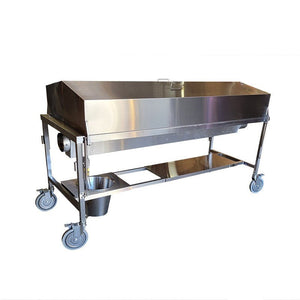
The USPE-1035-01 Pathology Grossing Station lists downdraft capture through its work surface and a 304 stainless steel work area. Its description also identifies configurable features such as a sink, formalin handling, height adjustment and photography equipment; the quote should state which are included.
Confirm where air is captured
Ask for a drawing showing the capture openings and the intended working position. Confirm whether the selected configuration captures air through the work surface, behind the work area or through another arrangement, and review how specimen placement may affect those openings.
Do not use a general “ventilated” label as the final specification. Have the equipment supplier and facility ventilation professional agree on the exact arrangement before the order is approved.
Confirm where the exhaust goes
The current USPE-1035-01 listing refers to a filter stage or facility exhaust without providing a complete model-specific ventilation schedule. Request that schedule and identify whether the ordered configuration connects to building exhaust or uses a specified treatment system (grossing station details).
- Ducted configuration: Ask for connection size and location, required airflow and pressure, fan responsibility and the intended discharge arrangement.
- Filtered configuration: Ask for the identified filter media, substances it is designed to address, replacement criteria and operating limitations.
- Room interface: Ask the facility team to review room ventilation, replacement air and the station's effect on the existing system.
A reference to a filter does not establish that it controls every chemical used in the room. Ask for performance documentation for the actual system and intended substances rather than accepting a generic filtration claim.
Separate equipment specifications from OSHA compliance
OSHA sets formaldehyde limits of 0.75 parts per million as an eight-hour time-weighted average and 2 parts per million as a 15-minute short-term exposure limit. The standard also establishes a 0.5-parts-per-million action level and employer responsibilities for exposure assessment and controls (OSHA 29 CFR 1910.1048).
These are workplace exposure requirements, not a blanket approval of a grossing station. The employer must address the standard's monitoring and control provisions for the actual conditions of use (OSHA formaldehyde standard, paragraphs (d) and (f)).
Request a complete utility schedule
Confirm the ordered voltage, phase, current and connection type, along with water, waste and any formalin-handling connections. If the work surface adjusts in height, ask how connected services accommodate that movement.
Include service access, cleaning requirements and the documentation needed for installation review. Do not treat a configurable feature as standard equipment unless the quote includes it.
Exposure monitoring is part of the operating plan
OSHA requires exposure assessment unless qualifying objective data demonstrate that foreseeable use cannot reach the action level or short-term limit. Repeat initial monitoring when changes in equipment, processes, personnel or controls may introduce new or additional exposure (OSHA, paragraph (d)).
If the latest results are at or above the action level, periodic monitoring is required at least every six months. If results are at or above the short-term limit, monitoring is required at least annually under worst conditions; these are conditional rules, not one universal annual schedule for every grossing room (OSHA, paragraph (d)(3)).
Downdraft, backdraft and combined arrangements
Ask where the capture openings are located and how the manufacturer expects the work to be positioned. The USPE-1035-01 listing identifies downdraft capture through the work surface, but the selected order still needs its own exhaust schedule (grossing station details).
For a rear-capture or combined arrangement, request the same drawing and operating documentation rather than assuming another station's requirements apply. Have the installation team review the planned tools, containers and working positions for interference with the identified capture openings.
Room ventilation and commissioning
Review the station and building systems together: supply air, exhaust, discharge location, adjacent equipment and access for maintenance. Ask who will install, balance and document the system and how performance will be checked under representative operating conditions.
The formaldehyde standard requires engineering and work-practice controls to reduce and maintain exposure at or below its limits, but it does not prescribe a universal airflow rate for this purchase. Obtain design values from the selected equipment documentation and the facility's qualified ventilation professional (OSHA, paragraph (f)).
Protective equipment and respiratory protection
A functioning ventilation system is not a blanket exemption from protective clothing, eye protection or other safety requirements. OSHA's formaldehyde provisions require protective-equipment selection based on the substance, conditions of use and hazards to be prevented (OSHA, paragraph (h)).
Where respiratory protection is required, the standard identifies the relevant operating circumstances and program requirements. Ask the facility safety team to specify appropriate protection; do not use a generic mask or cartridge recommendation from an equipment buying guide (OSHA, paragraph (g)).
Eyewash, cleaning and service planning
Include eyewash and emergency washing requirements in the room review. OSHA addresses splash hazards and hygiene protection separately from the station's ventilation, so those requirements should not be inferred from a downdraft feature (OSHA, paragraph (i)).
Before startup, assemble the equipment instructions, safety data sheets, facility procedures, exhaust schedule and service plan. Identify who maintains the station and any treatment system, and keep the inspection and exposure-assessment records required for its actual use.
Related pathology planning
Compare the grossing station collection and the vented-table comparison when planning the complete work area. Keep workstation specifications separate from a guarantee of room-wide regulatory compliance.
Prepare your grossing station request
Send the intended workflow, chemicals used, room plan and available utilities to American Mortuary Coolers. Include your facility ventilation contact so equipment and building requirements can be reviewed together.
