


Anatomy Dissection Table Buyer's Guide for Medical Schools & Universities 2026

Why Choosing the Right Anatomy Dissection Table Matters for Medical Schools
The anatomy dissection table sits at the center of every gross anatomy course. It determines workflow efficiency, biosafety compliance, ergonomic comfort for students and faculty, and the long-term viability of your cadaver program. Choosing incorrectly means costly retrofits, OSHA citations, and frustrated anatomy instructors — none of which your department can afford.
This guide is written for department chairs, lab directors, and facility planners at medical schools, osteopathic programs, physician assistant programs, and university anatomy departments. It covers every major table type, key specification decisions, and the compliance questions you must answer before purchasing.
American Mortuary Coolers & Equipment has supplied anatomy labs across the United States since 2009. We manufacture in Johnson City, Tennessee, sell factory-direct, and provide FREE Level 2 White-Glove Installation on qualifying orders. More than 7,500 customers trust our stainless steel anatomy and pathology equipment.
Types of Anatomy Dissection Tables — A Complete Overview
Standard Flat-Top Stainless Steel Dissection Tables
The baseline option for most gross anatomy labs is a flat-top stainless steel dissection table. These units feature a drain, perimeter channel, and seamless 304 or 316 stainless steel construction. They are straightforward to clean, resist the fixative chemicals used in cadaver preservation, and comply with most state health department standards for anatomical education facilities.
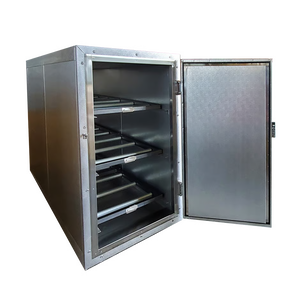
Flat-top models work well for programs that keep cadavers stored separately — either in a refrigerated cadaver storage unit or in an immersion tank — and wheel them to a standard table for dissection sessions. The table remains dry between sessions, reducing odor accumulation and simplifying housekeeping protocols.
Covered Dissection Tables for Anatomy Labs
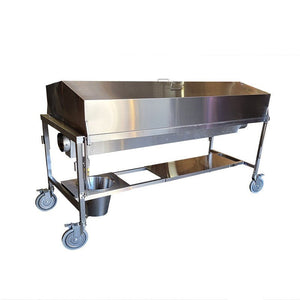
Programs with higher student-to-cadaver ratios, multiple daily sessions, or limited storage space increasingly specify covered dissection tables. These units feature a rigid polypropylene or stainless steel cover that seals over the cadaver between sessions, reducing formalin vapor release, limiting odor in the lab, and protecting cadavers from contamination.
The vented covered model (1035-06DT-V) adds a powered exhaust connection to the cover itself, actively drawing fumes away from the cadaver surface during sessions and between them. This is the configuration most often specified by environmental health & safety officers at research universities.
Adjustable Height Dissection Tables
Multi-user labs serving students of varying heights — and institutions with accessibility requirements under the ADA — increasingly specify adjustable height dissection tables. These units allow the work surface to raise and lower hydraulically or electrically, accommodating seated wheelchair users, shorter students, and tall faculty without forcing anyone into awkward postures during multi-hour dissection sessions.
The ergonomic case for adjustable-height tables in anatomy education is well-established. Studies in surgical education have demonstrated that sustained awkward posture during procedural training correlates with musculoskeletal discomfort and reduced performance. Anatomy programs that invest in adjustable tables report higher student satisfaction in facility surveys.
Immersion (Dip Tank) Dissection Tables
For programs that keep cadavers in fixative solution between dissection sessions — particularly those running semester-long or multi-year anatomy courses — electric immersion dissection tables and manual immersion dissection tables provide an integrated storage-and-work-surface solution. The cadaver is lowered into a tank of fixative (typically Carosafe or a modified formalin-free solution) and raised to the work surface for dissection. This dramatically reduces fixative vapor exposure during sessions because the cadaver rehydrates fully between uses.
Key Specification Decisions for Anatomy Lab Directors
Table Dimensions and Cadaver Capacity
Standard dissection tables run 84 inches long by 28–30 inches wide for full adult cadavers. Bariatric programs or labs receiving larger donors require extended dimensions. Always specify maximum expected donor weight in your RFP — standard tables typically support 400–500 lbs, while heavy-duty configurations handle 600+ lbs.
Drain Configuration and Waste Management
Anatomical waste, fixative, and biological fluids must route to a sanitary sewer system approved for anatomical waste in your state. Confirm your drain diameter, slope, and connection point before ordering. Tables with center drains versus end drains have different plumbing implications — work with your facilities team to confirm the preferred configuration before specifying.
Ventilation Requirements — Formalin vs. Formalin-Free Programs
Traditional gross anatomy programs using 10% buffered formalin fixative require local exhaust ventilation (LEV) at each table per OSHA 29 CFR 1910.1048. Programs that have transitioned to Carosafe, Biostat, or other formalin-free fixatives still benefit from ventilation at the table surface but may not be subject to the same regulatory threshold limits. Confirm your fixative protocol with EH&S before finalizing table specifications. See our Compliance Roadmap for a full regulatory overview.
Surface Finish and Corrosion Resistance
Grade 304 stainless steel is the minimum acceptable standard for anatomy dissection tables. Programs using higher fixative concentrations or chlorine-based disinfectants should specify grade 316 stainless, which contains molybdenum and provides superior chloride corrosion resistance. All American Mortuary Equipment tables use heavy-gauge stainless with fully welded seams — no crevices where biological material can accumulate.
Anatomy Lab Planning: Table Count and Layout
Student-to-Cadaver Ratios
AAMC guidelines and accreditation standards for MD programs do not mandate a specific student-to-cadaver ratio, but most programs plan for 4–6 students per cadaver in preclinical anatomy courses. A 40-student cohort requires 7–10 dissection tables, plus instructor demonstration tables and a preparation/transfer area. Plan for 120–150 square feet of clear floor area per table to accommodate students on all four sides plus instrument carts.
Table Spacing and Circulation
ADA-compliant circulation paths require 60-inch turning radius at each accessible table. OSHA recommends 36-inch minimum clear walkways in laboratory settings. In practice, most anatomy lab designers specify 48–60-inch center-to-table clearance to accommodate multiple students and instrument carts simultaneously.
Support Equipment for Each Station
Each dissection station typically requires: instrument tray or pan (stainless dissecting tray with wax, stainless dissecting pan), body positioner set (large plastic body positioner set), anatomical reference charts (anatomical chart set), overhead lighting, and a sharps disposal container. Budget for these per-station accessories in your total project cost.
Compliance and Accreditation Considerations
LCME and COCA Standards
The Liaison Committee on Medical Education (LCME) and the Commission on Osteopathic College Accreditation (COCA) both require that anatomy labs provide an educationally appropriate environment. While neither body publishes equipment specifications, site visit teams evaluate ventilation adequacy, safety protocols, and facility condition. Modern stainless steel dissection tables with proper ventilation and cover systems contribute to a strong accreditation showing.
State Anatomical Board Regulations
Most states with active body donor programs regulate the physical facilities used to receive, store, and dissect donated human remains. Contact your state anatomical board before finalizing lab design — requirements vary significantly. Our Compliance Roadmap provides a state-by-state reference for anatomy program operators.
Financing Your Anatomy Lab Equipment
Most medical schools and universities can deduct anatomy lab equipment under Section 179 of the IRS tax code — up to $1,250,000 in the year of purchase. This dramatically reduces the after-tax cost of a full lab outfitting. We offer 24-hour financing approvals for qualified institutions. Visit our Financing page or call 1-888-792-9315 to discuss options.
Related Resources
- Gross Anatomy Lab Setup Guide — Complete Equipment Checklist
- Anatomy Lab Equipment Checklist for Medical Schools
- Immersion Dissection Table Guide
- Anatomy Tables and Casework Laboratory Design 2026
- Dip Tank Dissection Tables Guide
- Ultimate Guide: Autopsy Tables for Forensic Infrastructure 2026
Get a Quote for Your Anatomy Lab
American Mortuary Coolers & Equipment manufactures anatomy dissection tables in Johnson City, Tennessee and ships factory-direct to medical schools, universities, teaching hospitals, and forensic science programs nationwide. Our team includes experienced anatomy lab planners who can review your floor plan, cadaver count, and accreditation requirements to recommend the right table configuration. Call 1-888-792-9315 or email service@mymortuarycooler.com to speak with a specialist. FREE Level 2 White-Glove Installation is available on qualifying orders.
American Mortuary Coolers & Equipment | Tennessee-Built Since 2009 | A+ BBB Rated | Pathology & Autopsy Equipment | Embalming Tables | Vault Morgue Coolers | All Mortuary Coolers | Financing | Compliance Roadmap | Contact Us | Warranty & Service
