


Immersion Dissection Table Guide — Keeping Cadavers in Fixative for Long-Term Anatomy Programs

What Is an Immersion Dissection Table and Why Do Anatomy Programs Use Them?
An immersion dissection table — also called a dip tank dissection table or immersion tank system — is a specialized anatomy lab workstation that allows a cadaver to be stored submerged in fixative solution within the table itself, then raised to the work surface for dissection sessions without requiring transfer to a separate refrigerated storage unit. The cadaver lives in the tank; the tank is the table.
This design solves one of the fundamental challenges of long-term gross anatomy education: maintaining cadaver tissue quality over a full academic semester or longer. Traditional fixed-position anatomy tables require cadavers to be stored separately — either refrigerated or in external tank systems — and transported to the dissection table for each session. Immersion tables eliminate this handling step and provide superior tissue preservation through continuous fixative immersion.
American Mortuary Coolers & Equipment manufactures both electric immersion dissection tables and manual immersion dissection tables in Johnson City, Tennessee. We sell factory-direct to university anatomy programs, medical schools, and research facilities nationwide. Call 1-888-792-9315 for specifications and pricing.
How Immersion Dissection Tables Work
Tank Design and Cadaver Capacity
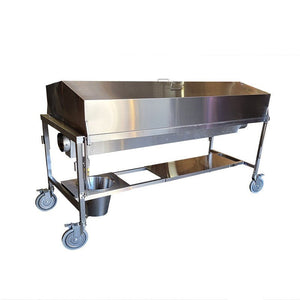
The immersion table consists of a heavy-gauge stainless steel tank — typically 84 inches long, 28–30 inches wide, and 18–24 inches deep — mounted in a frame that incorporates a lift mechanism. The tank holds fixative solution at a depth sufficient to fully submerge an adult cadaver. A sealed lid covers the tank when the lift is in the lowered (storage) position, minimizing fixative vapor release between sessions.
Tank volume for a full adult cadaver typically runs 150–250 gallons of fixative solution. The tank is filled once at program start and monitored for concentration and volume throughout the semester, with top-offs as needed to replace evaporation and absorption losses.
The Lift Mechanism
The lift mechanism — either electric or manual — raises a platform or tray from the bottom of the tank up to the work surface position, bringing the cadaver from submerged to dissection-ready without requiring anyone to reach into the tank or handle the cadaver manually. This dramatically reduces fixative skin and eye exposure for lab staff compared to manually lifting cadavers out of external tanks.
Electric lifts (in the electric immersion table) are controlled by a foot switch or hand pendant, raising and lowering the cadaver platform smoothly under power. Manual lifts (in the manual immersion table) use a hand-cranked or counterbalanced mechanism requiring physical effort from the operator. Electric is the preferred choice for high-frequency use and for accessibility compliance; manual is appropriate for lower-frequency programs or facilities without electrical connections at table positions.
Fixative Chemistry for Immersion Programs
Traditional Formalin-Based Fixatives
Traditional gross anatomy cadaver preservation uses 10% buffered formalin (3.7% formaldehyde solution) or higher concentration formaldehyde solutions. Immersion in formalin provides excellent long-term tissue preservation and kills essentially all pathogens within the cadaver. However, formalin is a known human carcinogen (IARC Group 1) and regulated workplace hazard under OSHA 29 CFR 1910.1048.
Immersion tables using formalin require sealed tank lids between sessions, local exhaust ventilation when the lid is open, and air monitoring per OSHA requirements. The sealed-tank design of immersion tables is actually advantageous for formalin programs compared to open cadaver storage in external tanks — less surface area exposed between sessions means lower vapor generation. See our Compliance Roadmap for detailed formalin regulatory guidance.
Modern Formalin-Free Fixative Systems
An increasing number of medical schools have transitioned to alternative fixative systems for environmental and occupational health reasons. The most widely adopted alternatives include:
- Carosafe: A propylene glycol and phenol-based fixative that provides good preservation without formaldehyde. Compatible with most immersion table systems.
- Thiel embalming solution: A multi-component fixative developed at the University of Dundee that produces unusually pliable, natural-feel cadavers particularly valued for surgical simulation training.
- Biostat: A preservative used in some European programs, not as widely available in North America.
Immersion tables work with all of these fixative systems — the tank and lift mechanism are material-agnostic. Confirm fixative compatibility with your institution's EH&S office before program launch.
Sizing and Capacity Planning
Table Dimensions vs. Donor Population
Standard immersion tables accommodate average-size adult cadavers (up to approximately 72 inches in length and 400 lbs). Extended-length or heavy-duty configurations are available for programs receiving larger donors. Always specify maximum expected donor dimensions in your RFP, not average — the limiting case determines the table specification you need.
Number of Tables for Your Program
Unlike traditional dissection table programs where tables may serve double duty as storage and dissection surfaces, immersion table programs typically dedicate one table per cadaver for the full semester. Each table requires a dedicated fixative fill, electrical connection (for electric models), and exhaust ventilation. Budget accordingly — these are purpose-built, semi-permanent cadaver management systems, not general-purpose work surfaces. See our guide to sizing immersion tables for university programs.
Floor Loading and Structural Considerations
A full immersion table with cadaver and fixative can weigh 2,000+ lbs. Verify your lab floor's structural load capacity before installation. Most modern lab floors support this loading, but older buildings may require structural assessment. Our installation team performs a site assessment as part of our FREE Level 2 White-Glove Installation service for qualifying orders.
Installation and Plumbing Requirements
Drain and Fill Connections
Immersion tanks require a fill connection (typically 3/4-inch supply) for initial tank filling and top-offs, and a drain connection (2-inch IPS minimum, 3-inch preferred for faster drainage) for annual fixative change or program end. Ensure the drain can handle the flow rate of a 150–250 gallon tank draining over a reasonable time period — a 2-inch drain at gravity flow takes 20–40 minutes to empty a full tank, which is acceptable for annual maintenance but inconvenient for more frequent changeovers.
Ventilation at Immersion Table Positions
When the lid is open during dissection sessions, local exhaust ventilation at the table position is required for formalin-based programs and strongly recommended for all immersion programs. Coordinate duct routing with your mechanical engineer before finalizing table placement in your floor plan.
Educational Benefits of Immersion Table Programs
Beyond the practical storage benefits, immersion table programs offer measurable educational advantages. Cadavers maintained in fixative between sessions retain better color differentiation, more consistent tissue texture, and superior pliability — all of which improve the quality of anatomical structures students can identify. Programs transitioning from refrigerated storage to immersion tables consistently report faculty observations of improved cadaver quality throughout the semester. See our Anatomy Lab Equipment: Immersion Tanks guide and Dip Tank Dissection Tables Guide for additional detail.
Related Resources
- Electric vs. Manual Immersion Dissection Table
- Cadaver Fixative Storage & Immersion Tables
- Immersion Dissection Tables for University Programs
- Dip Tank & Dissection Table Guide 2026
- Gross Anatomy Lab Setup Guide
- Body Donor Program Equipment Guide
Get Immersion Table Specifications and Pricing
American Mortuary Coolers & Equipment manufactures electric and manual immersion dissection tables factory-direct in Tennessee. Our team can assist with fixative system selection, floor plan layout, plumbing and ventilation coordination, and financing. Call 1-888-792-9315 or email service@mymortuarycooler.com. Section 179 deductions up to $1,250,000 apply, and 24-hour financing approvals are available for qualified institutions. FREE Level 2 White-Glove Installation on qualifying orders.
American Mortuary Coolers & Equipment | Tennessee-Built Since 2009 | A+ BBB Rated | Pathology & Autopsy Equipment | Embalming Tables | Vault Morgue Coolers | All Mortuary Coolers | Financing | Compliance Roadmap | Contact Us | Warranty & Service
