
Anatomy Lab Dissection Equipment — Complete Setup Guide for Medical Schools & Universities

Planning a Complete Medical School Anatomy Lab
Establishing or renovating a medical school anatomy lab requires coordinating equipment across multiple categories — dissection tables, accessories, cadaver storage, transport systems, educational models, and lab casework. Each category has specific performance requirements, installation dependencies, and regulatory compliance implications. This guide covers every equipment category required for a complete anatomy lab setup, with specification guidance and product recommendations from AMC's anatomy education line.
For related resources, see our dissection table guide, anatomy lab equipment and immersion tanks overview, and our complete pathology lab equipment package guide.
Category 1: Dissection Tables — The Core of Every Anatomy Lab
Electric Immersion Tables
AMC's electric immersion dissection table is the premium specification for high-volume anatomy programs with multiple daily sections. The motorized platform makes cadaver immersion and emersion effortless, enabling tight turnaround between lab sessions. Electric tables require electrical service at each table position — plan this in your facility design.
Manual Immersion Tables
AMC's manual immersion dissection table provides the same tissue preservation benefit as electric tables at a lower capital cost. The manually operated platform is appropriate for programs with lower daily immersion cycle frequency or programs where electrical service at each table position would require significant infrastructure investment.
Table Count Planning
Plan one dissection table per team of four to six students. Factor in a 10-15% reserve for maintenance, specialty demonstrations, and program growth. For a typical first-year class of 120 students with teams of 5, plan for 24-28 tables. Contact AMC for multi-table quantity pricing.
Category 2: Dissection Accessories
Stainless Steel Dissecting Trays
AMC's stainless steel dissecting tray with wax (Model 1035-15BWB) provides the dedicated surface for organ and specimen dissection. The wax interior allows pinning of specimens during dissection — essential for nerve and vessel tracing, which requires stabilizing the specimen in position during detailed work. Stainless steel construction provides full chemical resistance and cleanability.
Dissecting Pans
AMC's stainless steel dissecting pan (Model 1035-14DP) provides a containment surface for organ and specimen work. Dissecting pans collect fluids and loose tissue during specimen examination, keeping the table surface and surrounding area clean during detailed dissection work. Plan multiple pans per table for simultaneous multi-organ work.
Body Positioner Sets
AMC's large plastic body positioner set provides the positioning supports needed to stabilize cadavers in optimal dissection positions. Proper positioning is particularly important for extremity dissection and posterior approach procedures. Positioner sets should be provided for every table — improvised positioning solutions (rolled towels, blocks) are inefficient and inconsistent.
Category 3: Educational Models and References
Anatomical Charts
AMC's anatomical chart set (Model 1035-21CHT) provides comprehensive regional and systemic reference charts for use during cadaveric dissection. Charts allow students to correlate their cadaveric observations with idealized anatomical representations — the combination of cadaveric exploration and chart reference is the pedagogical core of anatomy education. Wall-mount charts near each dissection table for immediate reference access during lab sessions.
Anatomy Models
AMC's dual-sex human torso anatomy model provides a three-dimensional reference for structures that may be difficult to identify in cadaveric material, particularly for students early in the dissection program. Models are particularly useful for pre-lab orientation and post-lab review sessions where cadavers are not accessible.
Category 4: Cadaver Storage Refrigeration
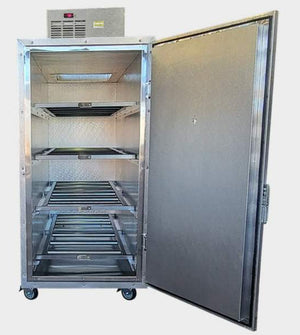
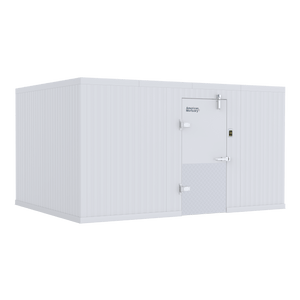
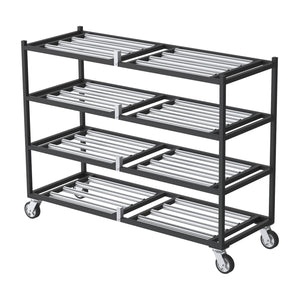
Anatomy programs require adequate refrigerated storage for the entire cadaver inventory. Between lab sessions, cadavers not stored in immersion tables require refrigeration to maintain tissue quality and prevent decomposition. AMC offers both vault-style and walk-in cooler configurations:
- Vault coolers (individual bay access): 6-bay, 12-bay — best for programs with moderate cadaver inventories
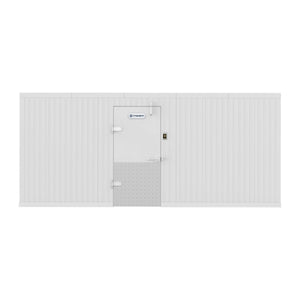
- Walk-in coolers: AMC's walk-in mortuary cooler line — best for large programs with 20+ cadavers
See our cadaver storage 2026 guide for capacity planning guidance.
Category 5: Transport Equipment
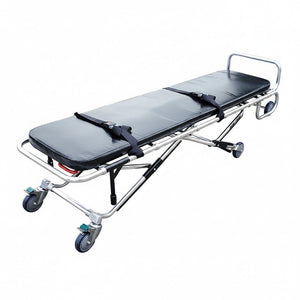
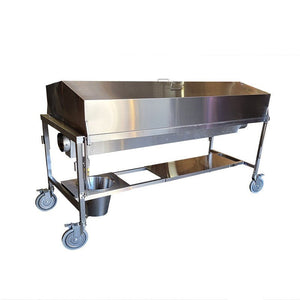
Cadaver movement within the anatomy facility requires appropriate transport equipment. AMC's cadaver stretcher carts and covered transport carts provide safe, dignified transfer from storage to the anatomy lab. The powered scissor lift assists with cooler tray loading for programs where manual lifting of heavy cadavers creates staff injury risk.
Category 6: Lab Casework and Sinks
AMC's custom stainless steel casework completes the anatomy lab environment: instrument storage, supply cabinets, and counter workspace for specimen and instrument management during dissection sessions. AMC's foot-pedal sinks provide hands-free hand washing stations essential for infection control compliance. See our stainless steel lab casework guide for complete design guidance.
Ready to plan your anatomy lab setup? Call 1-888-792-9315 or email service@mymortuarycooler.com. AMC's team will help you develop a complete equipment specification matched to your program size, curriculum, and facility. Section 179 deductions up to $1,250,000 apply, with 24-hour financing approval. Qualifying orders include FREE Level 2 White-Glove Installation. Visit our contact page or our about us page to learn more about AMC.
American Mortuary Coolers & Equipment | Tennessee-Built Since 2009 | A+ BBB Rated | Pathology & Autopsy Equipment | Embalming Tables | Vault Morgue Coolers | All Mortuary Coolers | Financing | Compliance Roadmap | Contact Us | Warranty & Service

