


Dissection Table Guide for Anatomy Labs — Electric vs. Manual Immersion Systems Compared

Why Immersion Dissection Tables Are the Standard for Medical Education
Human anatomy education depends on well-preserved cadaveric specimens that maintain tissue quality throughout a full academic semester or year. Traditional surface preservation methods — repeated application of topical preservatives, plastic sheeting, and refrigeration — are labor-intensive and produce variable tissue quality. Immersion dissection tables solve this problem by maintaining cadavers in a continuous preservative fluid bath when not in active dissection use, providing consistent tissue preservation with minimal staff intervention between lab sessions.
AMC offers both electric immersion dissection tables and manual immersion dissection tables for anatomy education programs. For a broader view of anatomy lab equipment, see our anatomy lab dissection equipment guide and our anatomy lab equipment and immersion tanks guide.
How Immersion Dissection Tables Work
The Fluid Bath System
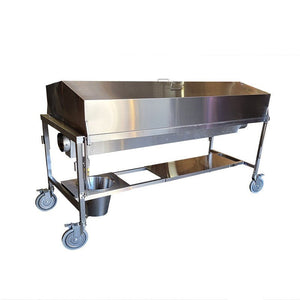
An immersion dissection table integrates a sealed fluid tank beneath or around the cadaver platform. When the cadaver is not in use, the platform is lowered into the tank (or fluid is raised to cover the cadaver) so that the entire specimen is submerged in preservative solution. The tank has a sealed lid to minimize evaporation and vapor release. Before each lab session, the cadaver is raised above the fluid level, excess fluid drains from the tissue, and dissection proceeds on the moist, preserved specimen.
Tissue Quality Benefits
Continuous immersion preservation maintains tissue hydration and pliability in a way that surface preservation methods cannot match. Anatomical structures remain recognizable and manipulable throughout extended dissection programs. Nerves, blood vessels, and fascial planes — the structures that students most need to identify and trace — retain their integrity through dozens of dissection sessions when properly immersed between uses.
Electric Immersion Tables: Features and Benefits
Motorized Platform Control
AMC's electric immersion dissection table uses a motorized mechanism to raise and lower the cadaver platform. The operator controls the platform height via a switch or control panel — no manual effort required for the immersion or emersion process. This motorized control is particularly valuable for anatomy programs where multiple lab sessions occur daily: the time and effort required to prepare multiple tables for each session is substantially reduced compared to manual systems.
Height Adjustment Integration
Many electric immersion tables also incorporate working height adjustment, allowing the raised platform to be positioned at the optimal dissection height for each instructor or student group. Combined fluid level control and working height adjustment in a single motorized system provides maximum ergonomic flexibility. See our electric immersion dissection table guide for detailed feature specifications.
Best Applications for Electric Tables
- High-volume anatomy programs with multiple lab sections per day
- Programs with larger cadaver inventories requiring frequent immersion/emersion cycling
- Programs prioritizing staff ergonomics and reduced manual effort
- Facilities with ADA-compliance requirements for motorized equipment operation
Manual Immersion Tables: Features and Benefits
Mechanical Simplicity
AMC's manual immersion dissection table provides the same fluid bath preservation benefit as the electric model through a manually operated mechanism. A hand crank, lever, or screw-jack system controls the platform height relative to the fluid level. Manual tables have no electrical components in the lift mechanism, reducing maintenance complexity and eliminating the failure mode of motor or control system malfunction.
Cost Considerations
Manual immersion tables offer a lower initial capital cost than electric models, making them the preferred choice for programs establishing an anatomy lab on a constrained budget, programs with lower cadaver volume (fewer immersion/emersion cycles per day), and programs where staff physical capacity is adequate for manual operation. The lower cost per table can be particularly significant for programs equipping a complete anatomy lab with many tables simultaneously.
Best Applications for Manual Tables
- Programs with lower cadaver inventory and fewer daily immersion cycles
- Budget-constrained initial lab setups
- Programs in facilities where electrical service at each table position would require significant infrastructure investment
Making the Decision: Electric vs. Manual
Volume and Frequency Analysis
The primary decision factor is the number of immersion/emersion cycles required per day. If each table is immersed and emersed once daily (one lab session per day), manual operation is manageable with minimal staff effort. If tables are cycled two or three times daily (multiple sections), the cumulative effort of manual operation across all tables in the lab becomes significant — and the electric system's labor savings justify the additional cost.
Total Cost of Ownership
Factor both capital cost and operating cost over the expected lab life (typically 15-20+ years for stainless equipment). Electric tables have higher initial cost but lower labor cost over the facility life. Manual tables have lower initial cost but require ongoing staff time for each immersion cycle. Quantify both costs to determine which is the better investment for your specific program volume.
Complementary Anatomy Lab Equipment
Complete your anatomy lab setup with AMC's full range of anatomy education equipment:
- Stainless steel dissecting tray with wax for pinning and specimen mounting
- Stainless steel dissecting pan for organ and specimen work
- Anatomical chart sets for reference during dissection
- Dual-sex human torso anatomy model for orientation and pre-dissection study
- Large plastic body positioner set for positioning during dissection
See our stainless steel dissecting trays and pans guide for specification details on dissection accessories.
Ready to equip your anatomy lab with immersion dissection tables? Call 1-888-792-9315 or email service@mymortuarycooler.com. AMC has equipped anatomy departments at medical schools and universities across the United States since 2009. Qualifying orders include FREE Level 2 White-Glove Installation, and Section 179 deductions up to $1,250,000 apply. Visit our contact page or browse our pathology and autopsy equipment collection.
American Mortuary Coolers & Equipment | Tennessee-Built Since 2009 | A+ BBB Rated | Pathology & Autopsy Equipment | Embalming Tables | Vault Morgue Coolers | All Mortuary Coolers | Financing | Compliance Roadmap | Contact Us | Warranty & Service
